0days left
National Administration of Traditional Chinese Medicine Issues the Action Plan for Traditional Chinese Medicine under the Medical and Health Foundation Strengthening Project (with Policy Interpretation Attached)
Author:广州医博会
Time:2026-07-29
Reader:403
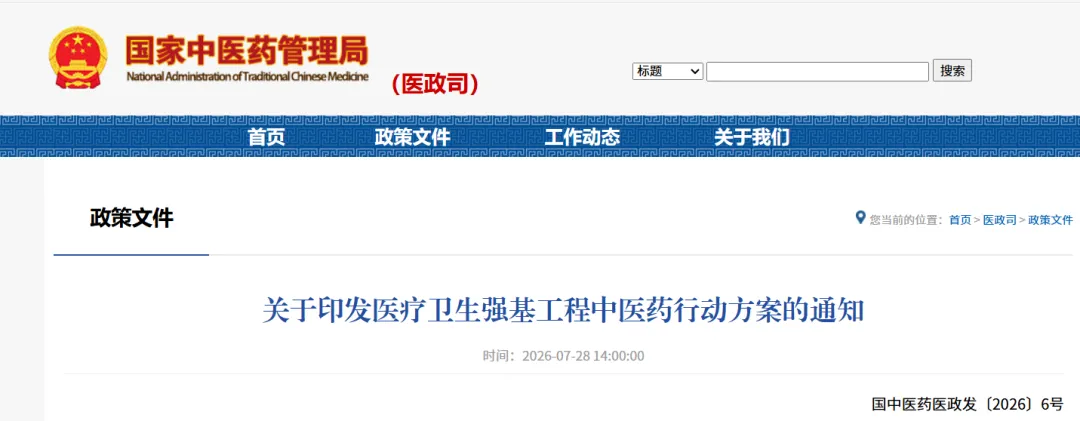
Health Commissions, Administrations of Traditional Chinese Medicine, Development and Reform Commissions, Education Departments (Bureaus), Finance Departments (Bureaus), Human Resources and Social Security Departments (Bureaus), Agriculture and Rural Affairs Departments (Bureaus), Medical Security Bureaus, Disease Prevention and Control Bureaus, and Drug Administration Bureaus of all provinces, autonomous regions, municipalities directly under the Central Government, and the Xinjiang Production and Construction Corps; relevant military units:
To implement the decisions and arrangements of the CPC Central Committee and the State Council on advancing the Initiative to Strengthen Primary Medical and Healthcare Services, consolidate and build on the outcomes of the 14th Five-Year Plan Project for Improving Service Capacity of Primary-level Traditional Chinese Medicine (TCM), and accelerate the revitalization and development of primary-level TCM, the National Administration of Traditional Chinese Medicine, National Health Commission, National Development and Reform Commission, Ministry of Education, Ministry of Finance, Ministry of Human Resources and Social Security, Ministry of Agriculture and Rural Affairs, National Healthcare Security Administration, National Disease Prevention and Control Administration, National Medical Products Administration, and the Logistics Support Department of the Central Military Commission have jointly formulated the Action Plan for Traditional Chinese Medicine under the Initiative to Strengthen Primary Medical and Healthcare Services. We hereby issue the Plan to you for earnest implementation.
National Administration of Traditional Chinese Medicine
National Health Commission
National Development and Reform Commission
Ministry of Education
Ministry of Finance
Ministry of Human Resources and Social Security
Ministry of Agriculture and Rural Affairs
National Healthcare Security Administration
National Disease Prevention and Control Administration
National Medical Products Administration
Logistics Support Department of the Central Military Commission
July 11, 2026
Action Plan for Traditional Chinese Medicine under the Initiative to Strengthen Primary Medical and Healthcare Services
This Plan is formulated to implement the decisions and arrangements of the CPC Central Committee and the State Council on advancing the Initiative to Strengthen Primary Medical and Healthcare Services and accelerate the revitalization and development of primary-level TCM.
I. General Requirements
Guided by Xi Jinping Thought on Socialism with Chinese Characteristics for a New Era, we will fully implement the guiding principles of the 20th CPC National Congress and all plenary sessions of the 20th CPC Central Committee, thoroughly study and apply General Secretary Xi Jinping’s important expositions on building a Healthy China and TCM work, and earnestly follow the Party’s guidelines on health and healthcare work for the new era. Focusing on reinforcing primary-level foundations, consolidating grassroots networks and safeguarding basic healthcare services, we will strengthen the primary service network, improve service conditions, boost service capabilities, highlight distinctive strengths, refine development policies, expand the supply of primary TCM services, support the development of the tiered medical care system, and enhance people’s sense of gain, happiness and security in seeking medical treatment.
By 2030, an integrated primary TCM service network covering prevention, treatment and rehabilitation will be fully established. The talent workforce will be further expanded, infrastructure and digital & intelligent conditions will be markedly improved, service capacity will grow steadily, and the important role of primary TCM in developing the tiered medical care system will be further highlighted. Centered on realizing the goal of universal access to TCM services, we will strive to ensure residents can reach the nearest medical service outlet within a 15-minute radius to receive TCM services. Efforts will be made to achieve quality upgrading in five key areas: medical service capacity of county-level TCM hospitals, TCM service capacity of primary medical and health institutions, staffing of primary TCM practitioners, promotion and application of appropriate TCM technologies at grassroots levels, and popularization of primary TCM health culture.
II. Key Tasks
(I) Initiative to Optimize and Improve the Service Network
Implement the functional positioning of county-level TCM hospitals.
County-level TCM hospitals shall mainly provide TCM services including diagnosis, treatment and nursing of common, frequently-occurring and chronic diseases, emergency treatment for critically ill patients, and upward referral of complicated and difficult illnesses within the county, and undertake corresponding public health functions. We will support county-level TCM hospitals in improving infrastructure and internal development. By 2030, all such hospitals will meet the Basic Standards for Medical Service Capacity of County-level TCM Hospitals, and over 50% will reach the Recommended Standards for Medical Service Capacity of County-level TCM Hospitals, enabling them to better play a leading role in county-wide TCM medical treatment, preventive healthcare, characteristic rehabilitation, personnel training, promotion of appropriate technologies and TCM health education. Support will be offered to counties without TCM medical institutions in remote areas to establish TCM institutions or set up TCM (including ethnic medicine) departments in general hospitals.
Upgrade service conditions of TCM clinics.
A proportion of township health centers and community health service centers will be supported to carry out capacity upgrading for TCM clinics, with priorities on improving TCM diagnosis and treatment conditions and developing featured specialized departments for specific diseases. By 2030, TCM clinics will be set up in all township health centers and community health service centers, and more than 30% of them will comply with the Standards for Capacity Improvement of TCM Clinics in Community Health Service Centers and Township Health Centers. We will promote standardized establishment of TCM service rooms in a certain number of community health service stations and village clinics.
Boost development of TCM clinical departments in non-TCM medical institutions.
We will advance the development of TCM clinical departments in county-level general hospitals, specialized hospitals, maternal and child health hospitals and other medical institutions. These departments will serve as hubs to guide and support TCM diagnosis and treatment in other clinical departments, and continuously enhance the capacity to deliver TCM services and integrated Chinese and Western medicine services. County-level general hospitals are encouraged to build clusters of integrated Chinese and Western medicine specialized departments. Pilot development of flagship primary medical and health institutions featuring integrated Chinese and Western medicine will be explored.
Encourage and standardize private investment in grassroots TCM services. Social forces will be guided to establish TCM medical institutions in counties, giving play to their strengths in traditional advantageous fields such as acupuncture and moxibustion, orthopedics and traumatology, anorectal diseases and rehabilitation. Privately-run TCM medical institutions shall enjoy equal rights with public TCM medical institutions in market access and practice. Comprehensive supervision will be strengthened to foster high-quality development.
(II) Initiative to Improve the Quality and Efficiency of Services
Develop county-level featured and advantageous TCM specialized departments. We will strengthen key departments in county-level TCM hospitals, requiring each county-level TCM hospital to build at least two featured and advantageous TCM specialized departments. Such departments will be incorporated into provincial alliances of advantageous TCM specialties. County-level TCM hospitals will host county-level TCM diagnosis and treatment guidance centers to provide guidance on specialized TCM diagnosis and treatment and continuously optimize the supply of TCM services in primary medical and health institutions.
Enhance county-level TCM emergency and first-aid capacity. We will improve emergency departments, intensive care units and other departments in county-level TCM hospitals, integrate emergency departments into county and district emergency medical systems, boost capabilities for emergency treatment and referral of severe and critically ill patients, and unblock green channels for emergency services. TCM-specific first-aid kits will be promoted, and training on TCM emergency technologies strengthened. Mechanisms for integrated Chinese and Western emergency treatment will be explored, and mobile backpack-based emergency medical teams jointly established at county and district levels.
Upgrade primary TCM pharmaceutical care capacity. Pharmacy departments in county-level TCM hospitals will be improved with adequate staffing of professional TCM pharmacists to lift the quality of pharmaceutical care. Eligible county-level TCM hospitals are encouraged to set up pharmaceutical preparation laboratories to develop locally distinctive TCM preparations. Support will be given to building county-level smart shared TCM pharmaceutical service centers and advancing intelligent upgrading of county-level pharmacies and herbal decoction rooms. Standardized management of Chinese herbal slices at county level will be strengthened.
Promote integration of TCM into basic public health services. We will continuously optimize TCM health management under basic public health service programs, focus on management of key populations and chronic diseases, enrich service contents, improve standards and enhance quality. The TCM health management coverage rate for the elderly and children will remain above 75% and 85% respectively.
Give full play to the unique strengths of TCM in basic medical care and health security for key groups. Practitioners of TCM working in primary medical and health institutions are encouraged to provide contracted family doctor services directly. We will develop the TCM nursing workforce and strengthen training on grassroots characteristic TCM nursing services. Campaigns to deliver standardized TCM services to grassroots communities will be launched. Grade I and Grade II TCM hospitals will be guided to extend integrated medical and elderly care services and support inclusive childcare services. Primary medical and health institutions are encouraged to adopt TCM therapies to provide community rehabilitation nursing, hospice care and weight management services. Leveraging TCM’s strengths in preventive treatment of diseases, we will strengthen guidance on TCM dietary therapy and promote health-preserving qigong such as Baduanjin. Pilots will be actively carried out to enable TCM to play a distinctive role in preventing and treating childhood and adolescent obesity, myopia, psychological and behavioral disorders, spinal deformities and dental caries.
(III) Initiative to Expand and Cultivate Grassroots Talent
Expand talent supply. A certain proportion of posts for TCM physicians will be reserved under the General Practitioner Special Post Program. Annual enrollment of free rural-oriented medical students majoring in TCM will be maintained above 1,000. The Special Program for College Graduate Village Doctors will be fully implemented with staffing guarantees in place. Local authorities are encouraged to recruit ethnic medicine practitioners into the grassroots TCM talent pool through examinations for practitioners with proven expertise. By 2030, TCM physicians will account for over 60% of all physicians in county-level TCM hospitals; the proportion in township health centers and community health service centers will stay above 20%. Every community health service station and 85% of village clinics will have at least one medical worker capable of providing TCM services.
Carry out tiered and categorized training. Talent development will focus on cultivating backbone TCM personnel at county, township and village levels. Training will be delivered to core staff of TCM clinics in county-level TCM hospitals and primary medical institutions to upgrade their TCM service capacity; standardized training will be offered to general practitioners and assistant general practitioners; knowledge and skill training on TCM will be organized for physicians and village doctors at grassroots levels. Construction of inheritance workshops for veteran grassroots TCM experts will continue.
Optimize talent deployment and management mechanisms. Standards for staffing and posts of grassroots TCM personnel will be refined, and recruitment and employment mechanisms improved. Talent management models including "county employment for township assignment" and "township employment for village assignment" will be promoted to encourage talent flow to grassroots areas. A sound system will be established requiring TCM personnel to regularly provide services at grassroots and remote border regions. Retired TCM practitioners in good health are encouraged to serve grassroots communities through various channels.
Improve incentive mechanisms for talent development. A talent evaluation system suited to the characteristics of TCM will be improved. Policies on targeted evaluation and targeted employment for professional titles of grassroots TCM technical personnel will be fully implemented. Evaluation criteria centered on clinical capabilities will be formulated for professional title promotion with preferential policies for grassroots practitioners, and institutional innovation will be leveraged to energize talent. In terms of salary distribution, performance appraisal and remuneration mechanisms conducive to boosting grassroots TCM service supply will be refined.
Promote downward mobility of TCM resources centered on personnel. We will advance paired assistance from tertiary hospitals to county-level TCM hospitals to sustain the flow of personnel and services to grassroots areas. Public Grade II and Grade III TCM hospitals will reserve a portion of specialist appointments for priority access by local primary medical and health institutions. A multi-level, extensive regular mobile medical service system will be established to cover all counties lacking TCM medical resources. A flexible service model combining fixed clinics and mobile medical services will be developed in light of local conditions. For counties without county-run TCM hospitals, mobile medical vehicles will be deployed to deliver itinerant TCM services in a coordinated manner.
(IV) Initiative to Deepen and Popularize Appropriate Technologies
Build a sound promotion system. Relevant institutions will support the development of national-level platforms for guiding the promotion of TCM diagnosis and treatment technologies and provincial-level promotion centers for appropriate TCM technologies. Local authorities are encouraged to build municipal-level promotion centers, and county-level promotion centers will be set up relying on county-level TCM hospitals. A complete promotion network will be formed with necessary TCM diagnosis and training equipment to disseminate appropriate TCM technologies to grassroots settings. Standards and management norms for promotion centers at all levels will be formulated. By 2030, county-level promotion centers for appropriate TCM technologies will cover all counties except sparsely-populated small counties.
Develop trainer teams. TCM experts with rich clinical experience and teaching capacity will be selected to train instructors for appropriate TCM technologies, forming a high-caliber tiered trainer workforce. By 2030, more than 1,000 provincial-level trainers will be trained. Each provincial promotion center will be capable of promoting over 65 types of appropriate TCM technologies, and each county-level center over 50 types.
Enhance clinical application capacity. The Manual of Appropriate TCM Technologies for Grassroots Settings will be widely promoted and revised with additional technical items in due course. Standards and management norms for grassroots appropriate TCM technologies will be formulated. By 2030, 80% of township health centers and community health service centers will be able to deliver more than 15 appropriate TCM technologies under six categories. A grassroots program named "Ingenious Therapeutic Techniques" will be piloted. Service packages of appropriate TCM technologies targeting common and frequently-occurring diseases such as neck, shoulder, waist and leg pain will be developed to provide distinctive TCM diagnosis and treatment services.
(V) Initiative to Innovate and Upgrade Comprehensive Management
Strengthen TCM medical quality management. We will improve county-level capacity for managing TCM medical services, and strengthen supervision and inspection over primary medical institutions on compliance with TCM industry standards, technical specifications, rational medication rules and core systems for medical quality and safety. Approaches and models for quality management tailored to grassroots TCM work will be explored. The Basic Norms for TCM Service Management in Township Health Centers and Community Health Service Centers will be strictly enforced. County-level general hospitals will be guided to deliver TCM services in reference to the Guidelines for TCM Work in General Hospitals (2024 Edition) to improve medical quality and management performance.
Raise the level of digital & intelligent services and management. We will accelerate the informatization development of county-level TCM hospitals, striving to achieve a 100% compliance rate for electronic medical record systems by 2030. Construction of smart TCM hospitals will continue. Application of medical artificial intelligence-assisted diagnosis and treatment technology will be explored in scenarios including grassroots TCM services and experience inheritance of veteran TCM physicians. Eligible regions are encouraged to deploy digital and intelligent terminals for TCM services.
Create national demonstration cities (counties) for grassroots TCM work. Policies including management measures and construction standards for national demonstration cities (counties) for grassroots TCM work will be refined to carry out the creation campaign. Typical experience and practices of grassroots TCM work will be summarized and promoted. Grassroots pioneering initiatives will be valued to amplify demonstration effects and fully integrate TCM into primary health services.
(VI) Initiative to Revitalize Integrated Health Popular Science and Cultural Industry
Improve grassroots capacity for TCM cultural services. County-level TCM medical institutions will be supported to build TCM health education bases and expand high-quality TCM cultural services. We will release a series of outcomes of the TCM Health Promotion Campaign under Healthy China Initiative, establish mechanisms to deliver premium cultural resources directly to grassroots communities, and increase supply of TCM popular science resources. Communication channels will be expanded. We will further develop distinctive cultural resources such as health regimens for traditional festivals and solar terms to meet people’s diverse health demands. By 2030, all county-level TCM hospitals will have standardized TCM health education bases.
Boost integrated development of grassroots TCM culture and health industries. Development of county-level TCM health industries will be encouraged. Integrated models combining modern Chinese herbal cultivation, leisure tourism and rural communities will be explored to build a modern industrial system that integrates herbal cultivation with secondary and tertiary industries. Sites of agricultural cultural heritage related to Chinese herbal medicines are encouraged to promote fine traditional Chinese culture and foster new forms of business including TCM study tours and health & wellness services. Social entities including time-honored TCM enterprises are encouraged to develop distinctive TCM products based on intangible cultural heritage of traditional medicine. High-quality development of TCM fairs will be promoted. In conjunction with the creation of healthy cities (counties) and national demonstration cities (counties) for grassroots TCM work, local authorities will advance in-depth integration and mutual advancement of TCM culture with catering, sports, performing arts, intangible cultural heritage and other sectors.
(VII) Initiative to Deepen Reform and Break Institutional Barriers for Empowerment
Leverage the role of TCM in building compact county-level medical communities. Guidelines will be formulated for county-level TCM hospitals to participate in compact county-level medical communities. Capable county-level TCM hospitals are encouraged to take the lead in establishing such communities, and a number of communities led by county-level TCM hospitals will receive support. County-level TCM hospitals and county-level general hospitals will coordinate to build county-level medical resource sharing centers to realize intensive utilization of resources, and develop compact county-level medical communities with TCM characteristics supported by digital and intelligent technologies. We will give play to TCM’s unique strengths in health management and disease prevention, and drive primary medical institutions to upgrade their capacity for preventive TCM treatment services.
Strengthen supporting medical insurance policies. Pilot payment by disease category for TCM dominant diseases will be carried out. Support will be provided for payment models including payment by disease category and per diem for TCM day wards and TCM rehabilitation wards. Appropriate premium allocation preference will be granted to compact county-level medical communities led by TCM hospitals. Primary medical institutions will be supported to deliver TCM services. TCM treatment expenses eligible for outpatient chronic disease policies will be reimbursed according to corresponding reimbursement ratios and annual caps specified in such policies. Macro-management of medical service prices will be strengthened, pricing items for TCM medical services regulated, and price adjustments for TCM services advanced in the dynamic adjustment of medical service prices.
Fulfill funding security responsibilities. Government investment commitments for TCM undertakings will be honored in accordance with regulations to strengthen support for grassroots TCM development. Budget performance management will be reinforced to ensure safe and efficient use of funds.
III. Safeguard Measures
Local authorities and relevant departments shall raise awareness, regard the implementation of the TCM Initiative under the Initiative to Strengthen Primary Medical and Healthcare Services as an important task to implement the Party’s guidelines on health and healthcare work for the new era, advance rural revitalization and build a Healthy China, incorporate relevant tasks into TCM development plans for the 15th Five-Year Plan period, fully implement all work tasks under the Initiative, and push forward implementation through comprehensive measures. Effective organizational leadership, investment policies and clear task division are required to promote work tailored to local conditions. Tracking and guidance will be strengthened, implementation progress regularly monitored and reviewed to ensure tasks are completed on schedule. Innovation and exploration will be encouraged; policy publicity, interpretation and training will be delivered, experience timely summarized and disseminated, and a favorable social environment fostered.
Policy Interpretation of the Action Plan for Traditional Chinese Medicine under the Initiative to Strengthen Primary Medical and Healthcare Services
Recently, the National Administration of Traditional Chinese Medicine together with 10 other ministries and commissions issued the Action Plan for Traditional Chinese Medicine under the Initiative to Strengthen Primary Medical and Healthcare Services (hereinafter referred to as the TCM Action Plan). Relevant interpretation is provided as follows:
I. Background of Formulation
General Secretary Xi Jinping pointed out that efforts should be made to promote the revitalization and development of TCM. The Strategic Plan for the Development of Traditional Chinese Medicine (2016–2030) explicitly requires continuous implementation of the Project for Improving Service Capacity of Primary-level TCM. Since the 12th Five-Year Plan period, the National Administration of Traditional Chinese Medicine has worked with multiple departments to successively roll out implementation plans and action plans for the 13th and 14th Five-Year Plan periods, which have effectively lifted primary TCM service capacity. In September 2025, the State Council approved the Implementation Plan for the Initiative to Strengthen Primary Medical and Healthcare Services, listing "accelerating the popularization and application of TCM at grassroots levels" as a key task. In July 2026, the State Council approved the 15th Five-Year Plan for the Revitalization and Development of Traditional Chinese Medicine, stressing continuous expansion of primary TCM service supply and consolidating grassroots foundations for TCM revitalization. To implement the decisions and arrangements of the CPC Central Committee and the State Council, the National Administration of Traditional Chinese Medicine, together with relevant departments, has conducted in-depth research and systematic planning, and decided to launch the TCM Initiative under the Initiative to Strengthen Primary Medical and Healthcare Services during the 15th Five-Year Plan period. The TCM Action Plan refines tasks set out in the Strategic Plan for the Development of Traditional Chinese Medicine (2016–2030), the Implementation Plan for the Initiative to Strengthen Primary Medical and Healthcare Services and the 15th Five-Year Plan for the Revitalization and Development of Traditional Chinese Medicine. With higher standards and more concrete measures, it promotes extension of TCM services to urban and rural grassroots communities, to residents’ doorsteps and daily life scenarios, further consolidates the foundation of TCM services, and improves the accessibility of TCM services and people’s sense of gain.
II. Main Contents
The TCM Action Plan consists of three parts: General Requirements, Key Tasks and Safeguard Measures. Key contents are as follows:
(I) General Requirements
This section defines the guiding ideology, working principles and overall goals. Contents are aligned with the Implementation Plan for the Initiative to Strengthen Primary Medical and Healthcare Services. Combined with the characteristics of TCM work, it includes requirements to thoroughly study and implement General Secretary Xi Jinping’s important expositions on TCM work. It sets the target of achieving quality upgrading in five dimensions by 2030: medical service capacity of county-level TCM hospitals, TCM service capacity of primary medical and health institutions, staffing of primary TCM practitioners, promotion and application of appropriate TCM technologies at grassroots levels, and popularization of primary TCM health culture.
(II) Key Tasks
Seven specific initiatives covering 25 key tasks are defined, along with division of responsibilities among ministries and commissions.
Initiative to Optimize and Improve the Service Network: four tasks including implementing the functional positioning of county-level TCM hospitals, upgrading service conditions of TCM clinics, boosting TCM clinical departments in non-TCM medical institutions, and encouraging and standardizing private investment in grassroots TCM services.
Initiative to Improve the Quality and Efficiency of Services: five tasks including developing county-level featured and advantageous TCM specialized departments, enhancing county-level TCM emergency capacity, upgrading primary TCM pharmaceutical care capacity, integrating TCM into basic public health services, and leveraging TCM strengths in basic medical care and health security for key groups.
Initiative to Expand and Cultivate Grassroots Talent: five tasks covering expanding talent supply, tiered training, optimizing talent deployment mechanisms, improving talent incentive policies, and advancing downward mobility of TCM resources centered on personnel.
Initiative to Deepen and Popularize Appropriate Technologies: three tasks including building a sound promotion system, developing trainer teams, and enhancing clinical application capacity.
Initiative to Innovate and Upgrade Comprehensive Management: three tasks including strengthening TCM medical quality management, lifting digital & intelligent service and management capacity, and creating national demonstration cities (counties) for grassroots TCM work.
Initiative to Revitalize Integrated Health Popular Science and Cultural Industry: two tasks to improve grassroots TCM cultural service capacity and boost integrated development of grassroots TCM culture and health industries.
Initiative to Deepen Reform and Break Institutional Barriers: three tasks on giving play to TCM in compact county-level medical communities, strengthening medical insurance policy support, and fulfilling funding security responsibilities.
(III) Safeguard Measures
This section clarifies that local departments shall fulfill responsibilities by raising ideological awareness, strengthening organizational leadership, reinforcing tracking and guidance, and encouraging innovation. Relevant tasks shall be incorporated into TCM development plans for the 15th Five-Year Plan period to ensure full, detailed and effective implementation of the TCM Initiative under the Initiative to Strengthen Primary Medical and Healthcare Services.
Source: Official Website of National Administration of Traditional Chinese Medicine
Prev The Exchange Meeting for Enterprises on Guangzhou Innovative Medicines and Medical Devices Catalogue was successfully held!
Next The coordination meeting for organizers and co-organizers of the parallel conferences of 2026 Guangzhou Medical Expo was successfully held
相关推荐
- Bay Area Connects Globally, Innovation Drives Health | 2026 Guangzhou Medical Expo Invites You to Attend This Grand Event 2026-05-22
- 2026 Guangzhou Medical Expo Scheduled for August! Building the Core Engine for the Greater Bay Area's Healthcare Industry. 2025-11-07
- Full-chain Empowers Industrial Innovation! The 2025 Guangzhou Medical Expo Successfully Concludes Today 2025-08-24
- Grand Opening of 2025 Guangzhou Medical and Health Industry Expo: Jointly Paint a New Blueprint for Health and Play the March of Industrial Endeavor 2025-08-22
-
Exhibition Overview
Exhibition IntroductionOrganizationExhibition RangePost exhibition reportExhibition Promotion -
Media Center
Exhibition DynamicsIndustry NewsExhibition PhotoExhibition VideoPartner -
Audience Center
Visit ScheduleVip Registration -
Exhibitor Center
invitationWhy To ExhibitScheduleExhibition Floor PlainBooth Reservation -
Concurrent Events
Forum activitiesRoadshowSigning -
Business Travel Service
City IntroductionExhibition HallSightseeingTraffic Guide -
Contact Us
About UsContact Us
Copyright Guangdong Silver Age Health Industry Co. Ltd.
粤ICP备2021159608号-6
 粤公网安备44010502003694号
TEL:+86 020-38109036 E-mail:eld@eldexpo.com Add:Room 3205-3207, Block E, Poly World Trade Center, 1022 Xingang East Road, Haizhu District, Guangzhou City.