0days left

It’s Official! China Releases a Heavyweight List of Medical Devices
Author:广州临研会
Time:2026-01-20
Reader:1318
AI Medical Device Development Direction Clarified: Intelligent Assistance, Surgical Robots, Brain-Computer Interfaces, and More......
01 List of Winners for 2025 AI Medical Device Innovation Tasks Announced
Over 100 Leading Entities Shortlisted
Recently, the official website of the Ministry of Industry and Information Technology (MIIT) issued the Notice on Announcing the Shortlisted Entities for the 2025 AI Medical Device Innovation Task "Challenge Initiative" (hereinafter referred to as the Notice).
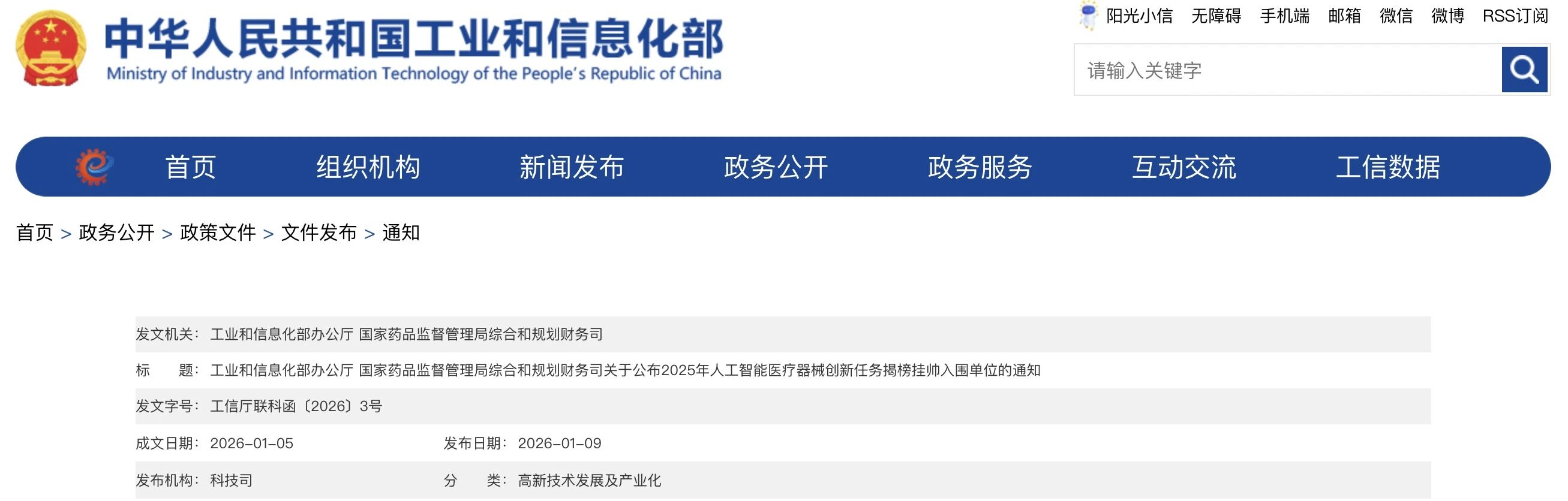
The Notice requires shortlisted entities to accelerate the advancement of research tasks as proposed in their application materials, ensuring the timely and high-quality completion of the "Challenge Initiative" tasks. Upon the completion of the research tasks, MIIT and the National Medical Products Administration (NMPA) will entrust relevant institutions to conduct evaluations, and select outstanding winning entities and projects on a merit-based basis.
The shortlist includes a total of 182 entities, covering three key areas: intelligent auxiliary decision-making, brain-computer hybrid intelligence, and supporting environments. Leading entities comprise tech giants, medical device manufacturers, universities, and hospitals, with details as follows:
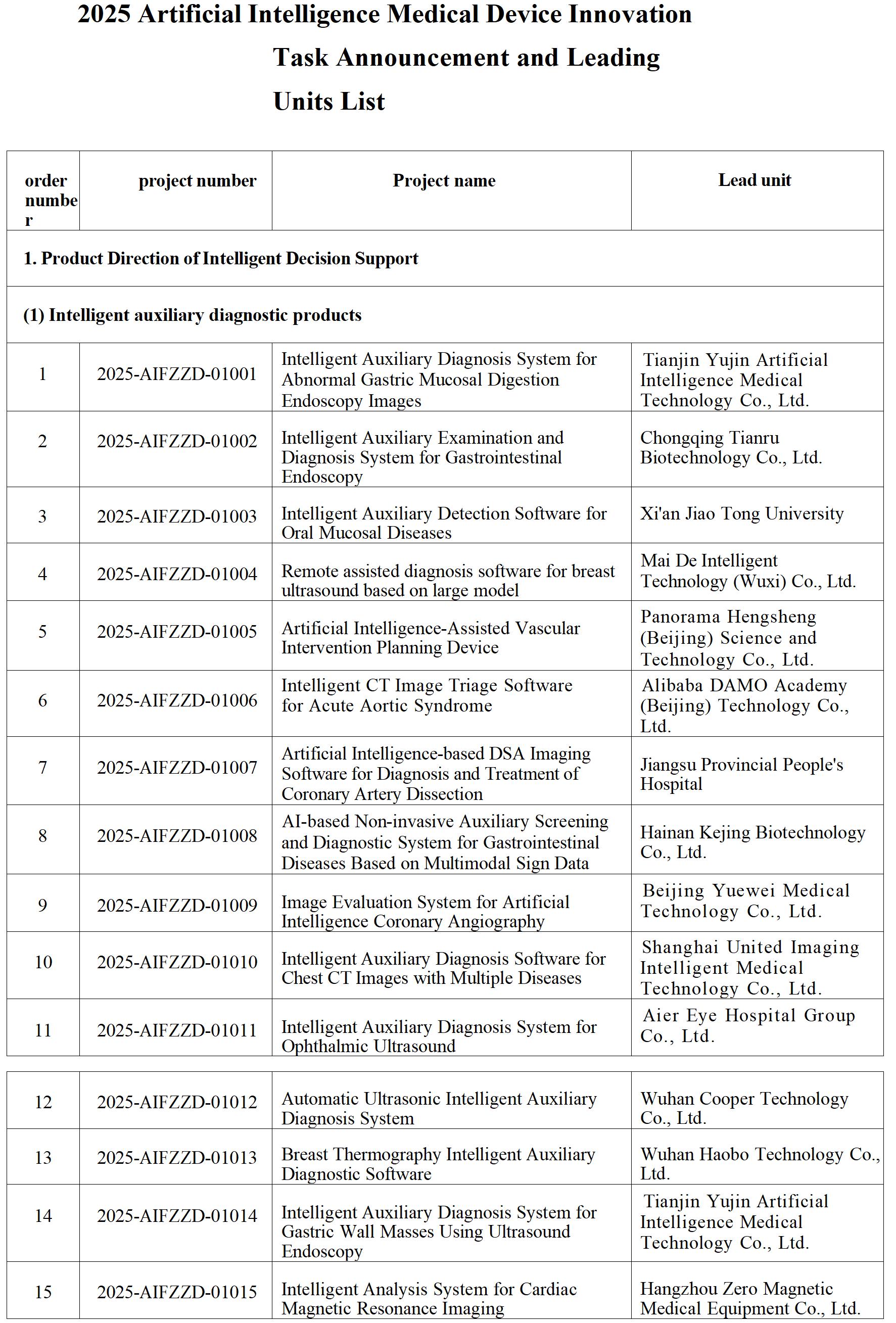
Full list available at the end of the article
Among these, intelligent auxiliary decision-making represents the current mainstream form of AI medical device products, including intelligent auxiliary diagnosis, intelligent surgical robots, intelligent digital therapeutics, and intelligent monitoring & life support systems. Within the intelligent auxiliary diagnosis segment, medical imaging accounts for the majority of the shortlisted projects. Examples include Alibaba DAMO Academy’s Intelligent Auxiliary Triage Software for CT Images of Acute Aortic Syndrome, United Imaging Intelligence’s Intelligent Multi-disease Auxiliary Diagnosis Software for Chest CT Images, and Xi’an Jiaotong University’s Intelligent Auxiliary Detection Software for Oral Mucosal Diseases.
The trend of medical-engineering integration is fully reflected in this list. Leading clinical institutions such as the First Affiliated Hospital of Nanjing Medical University, Peking University First Hospital, and the First Affiliated Hospital of Xi’an Jiaotong University have been shortlisted as leading entities, covering auxiliary diagnosis solutions for multiple specialties including cardiology and nephrology.
Since the early days of AI’s rise, medical imaging has been regarded as one of the most compatible application fields. AI-aided analysis of CT, MRI, X-ray, and other imaging modalities can be used to identify tumors, lesions, and other abnormalities. Leading domestic medical device companies such as United Imaging, Mindray, SonoScape, and Wandong have already launched relevant products.
In addition, intelligent auxiliary systems for lung cancer multidisciplinary consultation multimodal fusion and colorectal adenoma detection, as well as early screening tools for ALS and Alzheimer’s disease, have also been successfully shortlisted, indicating the expanding coverage of intelligent auxiliary decision-making technologies.
02 Accelerated Commercialization of Intelligent Surgical Robots; Full-Scale Takeoff of the Brain-Computer Interface (BCI) Track
The integration of surgical robots and AI has accelerated in recent years. The shortlisted projects cover multiple surgical scenarios including orthopedics, neurosurgery, cardiovascular surgery, and laparoscopy. Key entries include Tianzhihang’s Intelligent Lumbar Decompression and Fusion Surgical Robot System, Lepu Medical’s Intelligent Comprehensive Orthopedic Surgical Assistance Robot System, and the First Affiliated Hospital of Sun Yat-sen University’s Intelligent Liver Cancer Puncture and Ablation Surgical Robot System.
An analysis of project names reveals that the technical directions of AI surgical robots cover multiple routes such as intelligent navigation and positioning, mixed reality (MR) and visual navigation, and multi-channel and multi-surgical mode adaptation. Explorations have also begun targeting cutting-edge clinical fields such as natural orifice and non-invasive surgery.
As a recent favorite in the capital market, brain-computer interfaces (BCIs) occupy an independent segment in the list, with shortlisted projects covering all mainstream technical paths: invasive, interventional/semi-invasive, and non-invasive. These include traditional high-demand BCI tracks such as Xiangyu Medical’s Closed-Loop Transcranial Stimulation System for Refractory Depression and Galaxy Fangyuan Technology’s Transcranial Stimulation System for Alzheimer’s Disease.
The BCI-enabled vision therapy, which gained popularity thanks to Elon Musk’s initiatives, has seen follow-up efforts from multiple domestic enterprises. Examples include Renmin Hospital of Wuhan University’s Visual Rehabilitation Brain-Computer Interface System and China Electronics Cloud Brain’s Rehabilitation Training System for Dynamic Visual Defects.
Recently, eight ministries and commissions including MIIT issued the Implementation Opinions on the "AI + Manufacturing" Special Action, which aims to promote the iteration of intelligent equipment. The document specifically emphasizes accelerating the development of surgical robots, intelligent diagnostic systems, and other high-end medical devices, boosting the innovation and clinical application promotion of intelligent medical equipment products, as well as accelerating the industrialization of new terminals such as brain-computer interfaces. It is evident that this initiative is highly aligned with the AI medical device innovation tasks.
In November last year, five departments including the National Health Commission (NHC) and the National Development and Reform Commission (NDRC) jointly issued the Implementation Opinions on Promoting and Regulating the Application and Development of "AI + Healthcare", further clarifying the key application directions in the medical field.
AI is a foundational technology rather than a specific product category. From medical imaging to surgical robots and brain-computer interfaces, the development of high-end medical devices has become deeply integrated with AI technologies. While technological exploration continues, pathways for hospital adoption and payment reimbursement are also being expedited, marking the imminent arrival of the era of full-scale intelligence in medical devices.

Source: Saibolan Medical Devices
Author: Yue Qing
Prev A Comprehensive Review of Innovative Drugs Approved for Marketing in 2025
Next Invitation Letter | 2026 New Year Shopping Festival & Opening Ceremony of the Greater Bay Area Biomedical Technology Achievement Transformation and Verification Center
相关推荐
- Bay Area Connects Globally, Innovation Drives Health | 2026 Guangzhou Medical Expo Invites You to Attend This Grand Event 2026-05-22
- 2026 Guangzhou Medical Expo Scheduled for August! Building the Core Engine for the Greater Bay Area's Healthcare Industry. 2025-11-07
- Full-chain Empowers Industrial Innovation! The 2025 Guangzhou Medical Expo Successfully Concludes Today 2025-08-24
- Grand Opening of 2025 Guangzhou Medical and Health Industry Expo: Jointly Paint a New Blueprint for Health and Play the March of Industrial Endeavor 2025-08-22
-
Exhibition Overview
Exhibition IntroductionOrganizationExhibition RangeExhibition Promotion -
Media Center
Exhibition DynamicsIndustry NewsExhibition PhotoExhibition VideoPartner -
Audience Center
Visit ScheduleVip Registration -
Exhibitor Center
Why To ExhibitScheduleExhibition Floor PlainBooth ReservationDownload Center -
Concurrent Activities
Forum activitiesRoadshowCompany Promotion -
Business Travel Service
City IntroductionExhibition HallSightseeingHotel ReservationTraffic Guide -
Contact Us
About UsContact Us
Copyright Guangdong Silver Age Health Industry Co. Ltd.
粤ICP备2021159608号-6
 粤公网安备44010502003694号
TEL:+86 020-38109036 E-mail:eld@eldexpo.com Add:Room 3205-3207, Block E, Poly World Trade Center, 1022 Xingang East Road, Haizhu District, Guangzhou City.